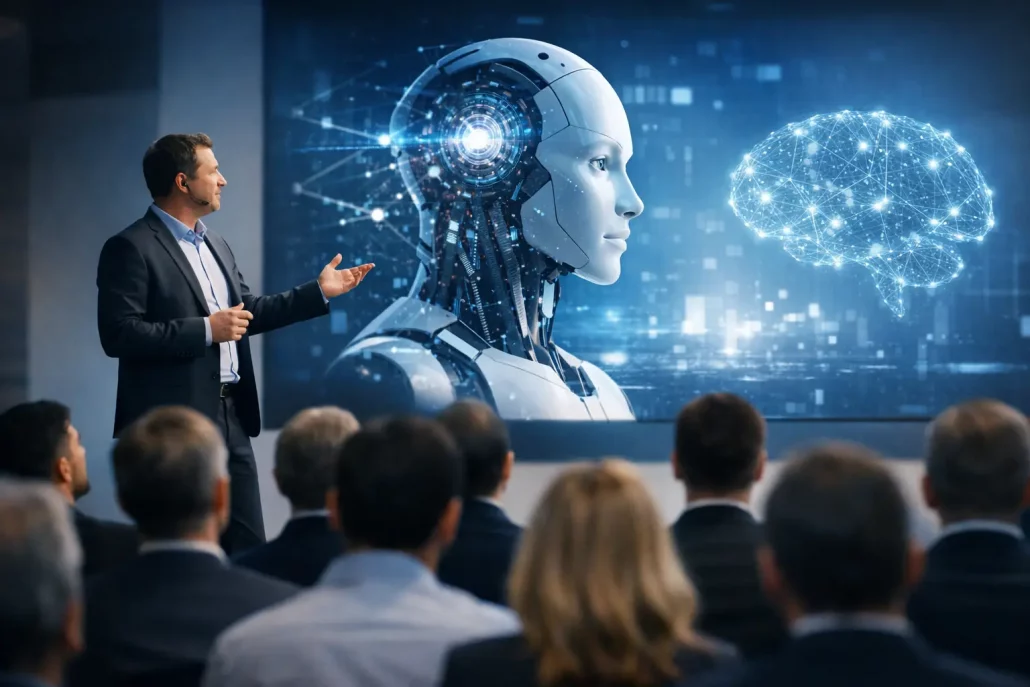
Most HR conference audiences can spot AI theater in the first five minutes. They know the difference between a speaker who has read the trend reports and one who has had to make workforce decisions when budgets were tight, skills were shifting, and leaders wanted answers fast. That is the real standard for an hr keynote speaker ai event planners should be looking for now.
This topic is no longer about novelty. It is about executive relevance. If a keynote on AI and HR does not help leaders think more clearly about capability, culture, workforce design, and decision quality, it will not land with a room full of CHROs, People leaders, or senior executives. The market is saturated with big claims. What audiences want is sharper judgment.
Why hr keynote speaker ai demand is rising
The rise in demand makes sense. HR is being pushed into a more visible strategic role as organizations sort through automation, productivity pressure, skills disruption, and employee trust. Boards want clearer workforce narratives. CEOs want practical guidance, not abstract concern. HR leaders need language that helps them lead both modernization and credibility at the same time.
That creates a specific opening for keynote content. A strong AI-focused HR keynote should do more than explain what generative AI is or list future trends. Senior audiences already have access to that information. What they need is interpretation. They need help separating signal from noise and translating technology change into operating choices.
This is where many speakers miss the mark. Some are highly technical but weak on organizational reality. Others are polished on stage but too general to be useful. The right speaker for this moment understands HR as a business function, not just a communication channel for change.
What makes an HR keynote speaker on AI credible
Credibility in this category is not built by using the most current terminology. It is built by proximity to real leadership work. Senior HR audiences are listening for whether a speaker understands the practical weight of decisions around talent deployment, risk, workforce planning, manager readiness, and employee confidence.
That means the strongest speakers typically bring three things together. First, they understand AI as a business shift, not just a tool shift. Second, they understand HR’s role in enterprise execution, not just culture messaging. Third, they can speak about experienced talent as an asset in transformation rather than framing modernization as a replacement exercise.
That last point matters more than many event organizers realize. A surprising amount of AI commentary still carries an undertone that capability only belongs to the newest, fastest, or most technical employees. In practice, organizations win when they pair institutional knowledge with modern tools. Experienced operators often make better judgment calls, spot risk faster, and understand where workflows actually break. A credible keynote should reflect that reality.
The content that actually resonates with executive audiences
For CHROs and executive teams, the best keynote themes sit at the intersection of people strategy and business performance. They are not interested in being told to simply embrace change. They want frameworks they can use in board conversations, leadership offsites, and transformation planning.
In practical terms, strong keynote content usually addresses questions like these: Where should HR lead, where should it partner, and where should it challenge in AI adoption? How do you modernize without devaluing trusted talent? What capabilities matter now for HR teams who want stronger executive influence? How do you protect trust while still pushing the organization toward greater speed and efficiency?
A keynote that can answer those questions with precision will outperform one built around generic futurism. This is especially true in rooms full of senior practitioners. They do not need inspiration detached from execution. They need a point of view that can survive contact with budgets, politics, and operational complexity.
What event planners should look for in an hr keynote speaker ai topic
If you are selecting a speaker, it helps to evaluate beyond stage presence. Presence matters, but relevance matters more. Ask what the audience should be able to do differently after the session. If the answer is vague, the keynote probably is too.
A useful AI keynote for HR leaders should create movement in at least one of three areas. It should sharpen strategic thinking, improve executive language, or provide a practical decision framework. Ideally, it does all three. The audience should leave with a clearer understanding of where HR can create value in AI-era transformation and how to talk about that value with authority.
It also helps to assess whether the speaker can calibrate for the room. A national HR conference, a private executive retreat, and an internal leadership summit may all use similar language around AI, but they do not need the same message. Sometimes the room needs a challenge. Sometimes it needs alignment. Sometimes it needs a more grounded reset after months of inflated expectations.
That is one reason practitioner-led speakers are so effective. They are typically better at reading what the audience actually needs rather than defaulting to a fixed script.
The trade-offs behind different speaker choices
There is no single perfect type of AI keynote speaker for every event. It depends on the outcome you want.
A technology futurist may be useful if your goal is to broaden thinking and generate energy around innovation. The trade-off is that they may oversimplify the organizational and workforce implications. A pure HR thought leader may be strong on people strategy and weaker on the actual implications of AI adoption. A current or former operator with deep HR experience often brings more balance, especially if the audience includes enterprise decision-makers who care about implementation, capability, and risk.
That balance is where the strongest outcomes tend to happen. Senior leaders do not need fear-based messaging, and they do not need cheerleading. They need disciplined optimism. They need a speaker who can say yes, AI changes work significantly, and also yes, leadership judgment still matters. In many cases, it matters more.
Why human-centered does not mean slow or soft
One of the weakest assumptions in the AI conversation is that human-centered leadership is somehow opposed to performance. In strong organizations, the opposite is true. Human-centered transformation is often the only path to sustained adoption because people implement what they understand, trust, and see themselves in.
For HR audiences, this distinction is critical. The role of HR is not to slow modernization down until everyone feels comfortable. It is to help the organization modernize in a way that improves capability, decision quality, and resilience. That requires candor. Some roles will change materially. Some workflows should be redesigned. Some skills will lose value while others rise. But none of that requires dismissing the contribution of mature talent or treating experience as outdated.
A serious keynote should make that case with clarity. It should position experienced employees and leaders as force multipliers when they are given the right tools, context, and expectations. That message is not sentimental. It is operational.
What a strong keynote should leave behind
The real test of a keynote is what happens after the applause. Do leaders have language they can use on Monday? Do they have a better way to frame the workforce conversation with the CEO, the board, or their own teams? Do they have a more grounded understanding of where AI belongs in their people strategy and where it does not?
That is the standard worth holding. A good keynote creates attention. A strong keynote creates executive traction.
For organizations navigating workforce transformation, that distinction matters. AI is not just a content theme now. It is a leadership test. The right speaker helps leaders meet that test with more discipline, more confidence, and a clearer view of the value HR is positioned to create. That is the kind of perspective brands like Everstrong Leadership are built to bring into the room.
Choose a speaker who respects the complexity of the moment and can still make it actionable. Senior audiences do not need louder commentary. They need better thinking.
Bring Lorraine to your team.
Speaking engagements, executive workshops, and HR leadership strategy.