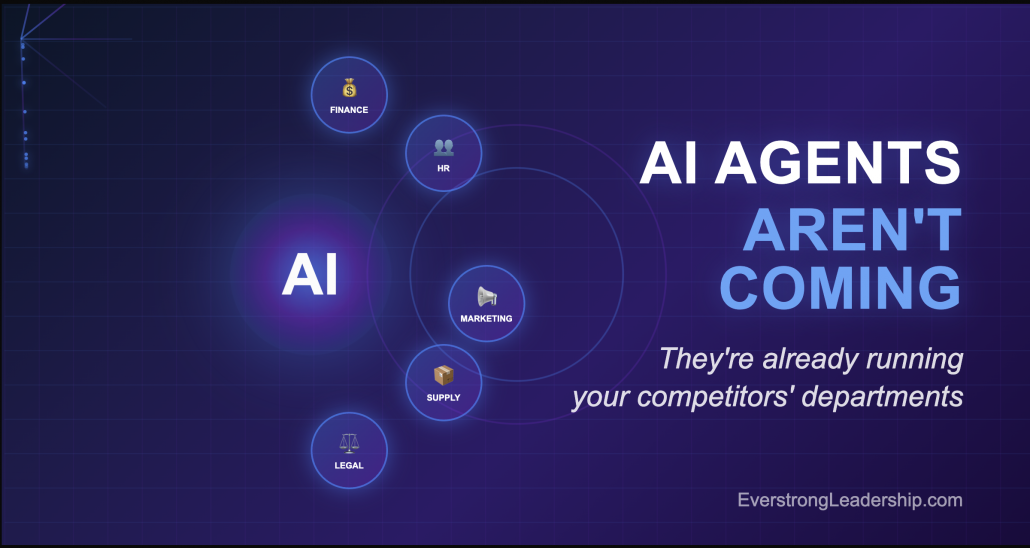
The most significant AI shift of 2025 wasn’t chatbots or image generators. It was the arrival of autonomous AI agents: software that stopped waiting to be asked and started planning, deciding, and executing on its own. Most business owners still haven’t noticed.
What actually changed
AI used to wait for you to ask it questions. Now it runs whole processes end to end, including planning, deciding, and executing against business objectives while you sleep. McKinsey calls this agentic AI, and enterprise pilots are widespread.
Look at where it’s already operating. Finance teams have cut reporting time substantially. HR teams have compressed time-to-hire. Marketing organizations are producing localized content across hundreds of markets far faster than before. Supply chain groups are predicting demand and reordering ahead of stockouts. Legal teams have cut contract review time sharply.
Notice the pattern. These aren’t experiments. They’re operational infrastructure.
Autonomous AI agents aren’t only a Fortune 500 story
A twelve-person marketing agency automated proposals, contracts, and invoicing with off-the-shelf tools and reclaimed the equivalent of a full-time hire without hiring anyone. The barrier to entry here is lower than most leaders assume, which is exactly what makes the gap between early and late movers widen so fast.
What’s coming next
The next step isn’t agents working for you. It’s agents working with each other. Procurement systems negotiating with vendor systems in real time. Marketing, HR, and finance workflows syncing without anyone sending an email to coordinate them.
That future needs governance more than it needs enthusiasm. The NIST AI Risk Management Framework is a sensible starting point for deciding what an agent is allowed to do on its own.
Where to start
The real question isn’t whether to use autonomous AI agents. It’s which process in your business is burning the most hours right now, because that’s where you start. Don’t ask what tool to buy. Ask what drains the most time, then go look at it honestly.
Before you hand anything over, settle who is accountable for the outcome. That’s the subject of who owns workforce AI, and the practical test for what should be automated at all is in when should HR automate decisions.
Bring Lorraine to your team.
Speaking engagements, executive workshops, and HR leadership strategy.