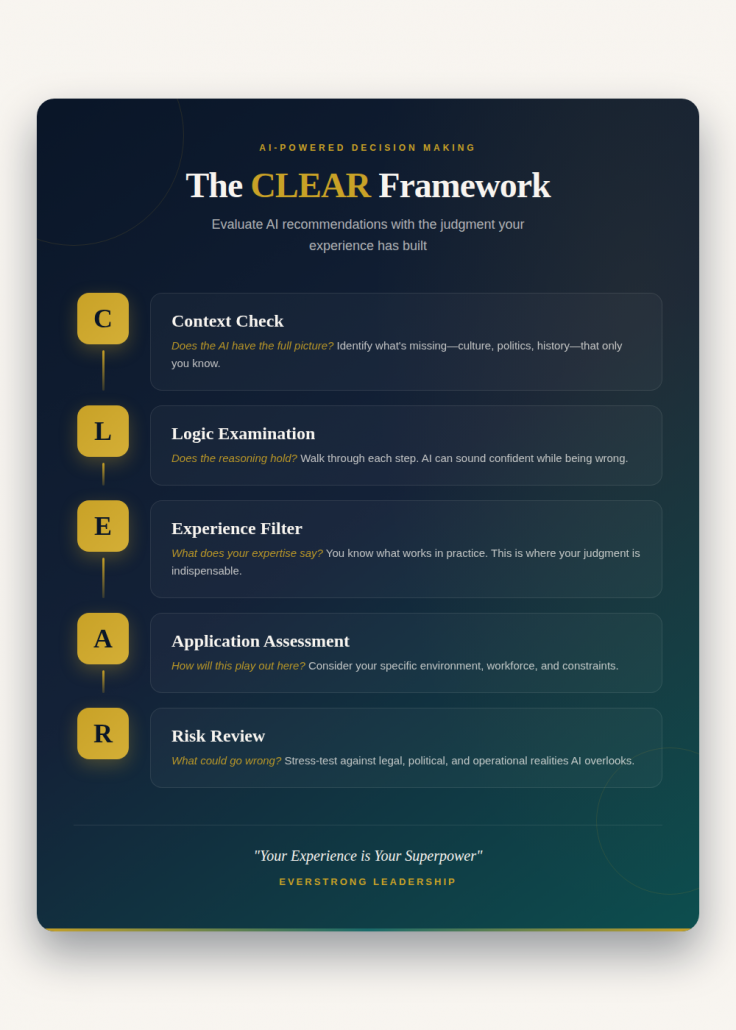
The conversation around AI in HR has shifted. We’re no longer debating whether to adopt these tools. We’re figuring out how to use them well, and that’s where a lot of experienced leaders get stuck. The CLEAR framework is the method I use to close that gap.
After years of guiding senior HR executives through AI transformation, I’ve noticed a pattern. The challenge isn’t the technology. It’s knowing when to trust AI outputs, when to push back, and how to blend machine-generated insight with judgment you’ve built over decades.

What the CLEAR framework stands for
C – Context Check. Does the AI have the complete picture? Large language models work with whatever information you provide. They don’t know your company culture, your CEO’s risk tolerance, or the political dynamics of your leadership team. Before accepting any recommendation, ask what context is missing.
L – Logic Examination. Walk through the reasoning. AI can sound confident even when it’s completely wrong. Break the recommendation down step by step. Does each leap make sense? Are there assumptions baked in that don’t apply to your situation?
E – Experience Filter. This is where your expertise becomes indispensable. You know which policies look great on paper and fail in practice. You know the difference between what employees say they want and what actually drives engagement. Run every suggestion through that filter.
A – Application Assessment. How will this play out in your specific environment? A recommendation that works beautifully at a tech startup can create chaos at a traditional manufacturer. Workforce demographics, industry constraints, geographic spread. AI doesn’t account for these on its own.
R – Risk Review. What could go wrong? AI tends toward optimistic recommendations. It won’t surface the legal landmines, the union implications, or the executive who will torpedo any initiative that wasn’t their idea. Stress-test everything against real-world risk.
Putting the CLEAR framework into practice
Say you’re using AI to design a new performance management approach and the tool suggests eliminating annual reviews in favor of continuous feedback. Run it through the five checks.
Context: does the AI know your organization just came through a complex restructuring and managers are already overwhelmed? Probably not. Logic: the reasoning may be sound in general, but does it account for regulatory requirements in every country where you operate? Experience: you’ve seen continuous feedback initiatives before, and you know they need serious manager training to work. Has that investment been factored in? Application: part of your workforce is on a manufacturing floor without regular computer access, so how does continuous feedback reach them? Risk: what happens to your legal documentation if a termination is challenged and there are no formal review records?
The AI recommendation isn’t wrong. It’s incomplete. Your expertise fills the gaps.
Why this matters now
Organizations are making significant decisions about AI adoption, and HR leaders will either lead that transformation thoughtfully or get swept along by the hype. The leaders who thrive won’t be the ones who reject AI or accept its outputs uncritically. They’ll be the ones who understand that AI amplifies human judgment rather than replacing it.
Governance matters here too. The NIST AI Risk Management Framework is a useful companion when you’re setting organizational guardrails rather than evaluating a single recommendation.
Your experience isn’t a liability in the age of AI. It’s exactly what makes you capable of using these tools well. If you want the longer argument, that’s the subject of The Experience Amplifier. For the practical question of where AI belongs in HR decisions at all, see When Should HR Automate Decisions?
Lorraine Neal is the founder of Everstrong Leadership and Director of People & Culture at ATPCO. She helps senior HR executives use AI to amplify their expertise rather than compete with it.
Bring Lorraine to your team.
Speaking engagements, executive workshops, and HR leadership strategy.